Published September 7, 2026 · Sumit Yadav
AEP, RTCDP, AJO, CJA — What's the Difference? (A Simple Guide)
If you’ve ever heard the terms AEP, RTCDP, AJO, and CJA thrown around in the same conversation and felt a little lost about how they relate to each other, you’re not alone. This is, hands down, the most common point of confusion we see from people reaching out for Adobe Experience Cloud training. So let’s clear it up in plain language, no jargon.
Think of it like a smartphone
The easiest way to understand this ecosystem is to compare it to a smartphone:
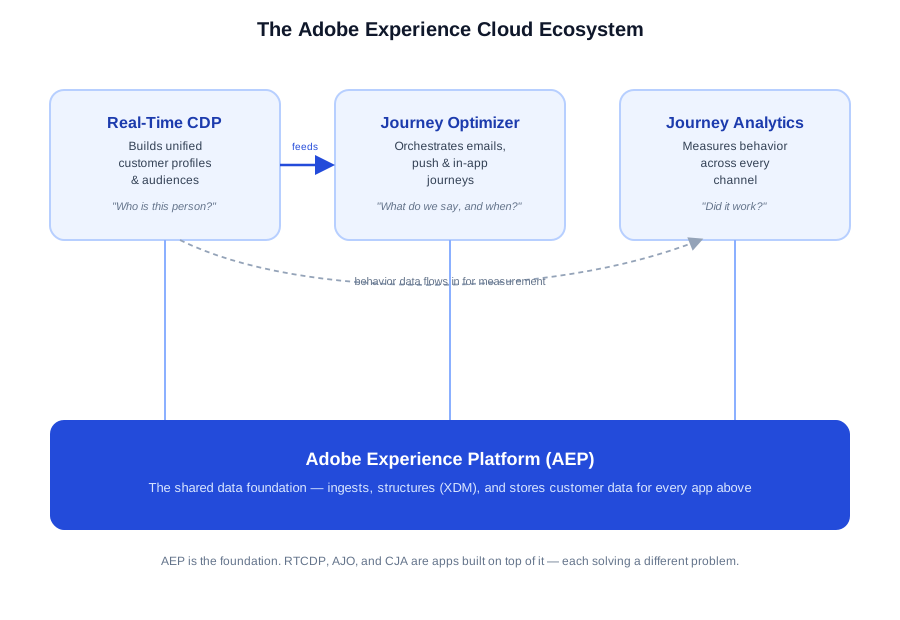
- Adobe Experience Platform (AEP) is like the phone’s operating system. It’s the foundation everything else runs on. On its own, an operating system doesn’t do much for the end user — it just provides the plumbing: where data lives, how it’s structured, and how different apps can talk to each other.
- Real-Time CDP (RTCDP), Adobe Journey Optimizer (AJO), and Customer Journey Analytics (CJA) are like apps installed on that phone. Each one uses the OS’s underlying data and capabilities to do a specific job.
So when someone says “AEP,” they usually mean the whole platform. When they say “RTCDP,” “AJO,” or “CJA,” they mean one specific app running on top of it.
What each one actually does
Adobe Experience Platform (AEP) — the foundation AEP is the underlying data layer. It ingests data from all your sources (website, app, CRM, POS, support tickets, and more), organizes it into a common format called XDM (Experience Data Model), and stores it in a way every other Adobe app can use. Think of it as answering: “Where does all our customer data live, and how is it organized?”
Real-Time CDP (RTCDP) — builds the customer profile RTCDP sits on top of AEP and stitches all that data into a single, unified profile for each customer, then lets you segment those profiles into audiences. Think of it as answering: “Who is this person, and what do we know about them?”
Adobe Journey Optimizer (AJO) — acts on the profile AJO takes those unified profiles and audiences from RTCDP and uses them to actually do something — send an email, trigger a push notification, personalize a website banner, or orchestrate a multi-step journey like a cart-abandonment sequence. Think of it as answering: “Now that we know who this person is, what should we say to them, and when?”
Customer Journey Analytics (CJA) — measures what happened CJA sits on the same underlying data and lets you analyze customer behavior across every channel in one place — did the email get opened, did they come back to the site, what was the actual path to purchase? Think of it as answering: “Did it work, and what can we learn from it?”
A simple example: cart abandonment
Let’s say a customer adds a laptop to their cart on your website but doesn’t check out.
- AEP stores the raw event data (what page they visited, what they added to cart) in a common data model, so it’s usable everywhere.
- RTCDP stitches this event to that customer’s unified profile — now the system knows this specific person abandoned this specific item.
- AJO sees this profile update and triggers a journey: send a reminder email in 1 hour, then a discount code push notification the next day if they still haven’t purchased.
- CJA later reports on how many abandoned-cart journeys led to an actual purchase, so you know if the strategy is working.
Four different jobs, one connected system — each one depends on the layer below it, but each also solves a distinct problem on its own.
Where to start
If this is the first time these terms have clicked into place, you’re in good company — most people learn this ecosystem the same way: hands-on, one piece at a time, rather than trying to memorize definitions. Our RTCDP course and AJO course cover the foundations described above and are designed to work well together.
Have questions about which one to start with? Reach out — happy to point you in the right direction based on where you’re starting from.
Related guides
- Why the Same Browser Doesn't Always Mean the Same Customer in AEPJohn logs in, then Jane, then John again — same browser, same ECID. Here's how Adobe Experience Platform's identity graph avoids collapsing them into one person.
- AEP and AJO: How Real-Time Journey Orchestration WorksLearn how Adobe Experience Platform and Adobe Journey Optimizer work together to turn unified customer data into event-driven, real-time journeys.
- Reference Architecture for AEM, AEP, AJO, and CJADesign an Adobe reference architecture connecting AEM, AEP, AJO, and CJA with clear data flows, identity, consent, governance, and global operations.
Need this implemented in your org?
I'm available for freelance and consulting engagements on AEM, EDS, RTCDP, AJO, and Adobe Target. See how we can work together →